
You found a hotel rate that looked reasonable.
Then the total changed.
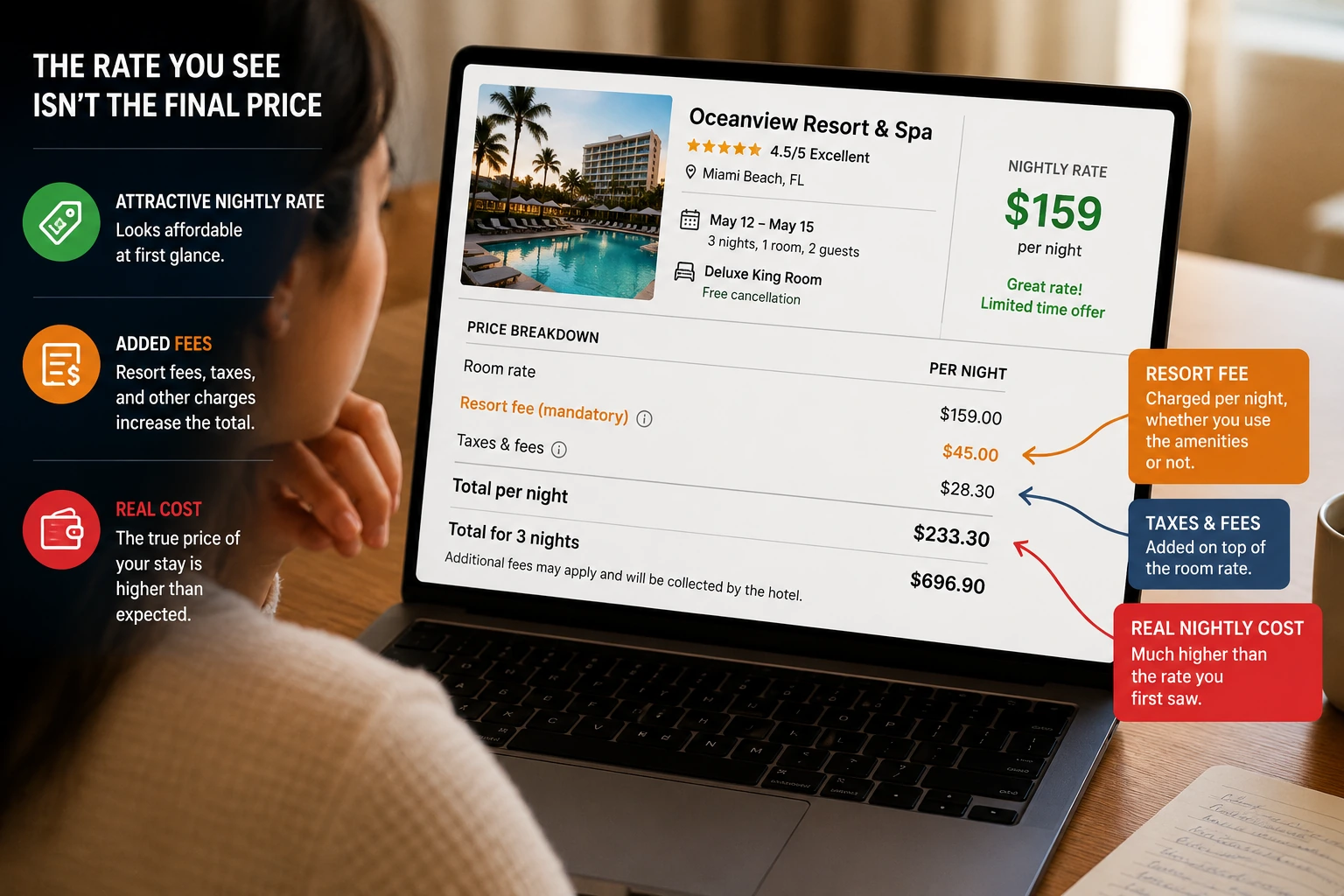
Maybe a resort fee appeared at checkout. Maybe it was listed as a property fee, destination fee, amenity fee, or facility fee. Maybe you did not notice it until the hotel asked for payment at check-in.
That can make the hotel feel more expensive than the price you originally compared.
In most cases, a hotel resort fee is not optional. It is usually a mandatory daily charge added to the room rate, even if you do not use the amenities it supposedly covers.
But that does not always mean it was easy to understand before you booked.
The real question is not just:
“Do I have to pay the resort fee?”
It is:
“Was this fee part of the real cost of the stay, and could I have booked differently to avoid, reduce, or include it?”
This guide explains what hotel resort fees are, why hotels charge them separately, when they usually apply, and what to check before you choose a hotel based on the nightly rate.
Quick Answer
What are hotel resort fees?
Hotel resort fees are usually mandatory daily charges added on top of the room rate. They may be described as covering Wi-Fi, pool access, gym use, bottled water, beach towels, local calls, shuttle service, or other property amenities.
You usually have to pay the fee even if you do not use those amenities. The key is to check whether the resort fee, property fee, destination fee, or amenity fee is included in the total price before booking — and whether your loyalty status, award stay, package, corporate rate, or booking channel waives or offsets it.
Why Resort Fees Exist
Hotel resort fees exist because some hotels separate part of the stay cost from the advertised room rate.
That separation can make the nightly rate look more competitive when travelers compare hotels in search results, booking platforms, or map listings.
Instead of showing the full cost as one room price, the hotel may display a lower base rate first and add the resort fee later in the booking path.
That fee may be described as covering amenities such as Wi-Fi, pool access, fitness center use, bottled water, beach chairs, local calls, shuttle service, or other property benefits.
But the fee usually applies whether you use those amenities or not.
A resort fee is not usually a menu of optional services. It is part of the hotel’s pricing structure.
Resort Fees May Use Different Names
Hotels do not always call the charge a resort fee.
Depending on the property, destination, or booking platform, the same type of mandatory fee may appear as a destination fee, amenity fee, property fee, facility fee, urban fee, or experience fee.
The name matters less than the structure.
If the charge is mandatory, added to the room rate, and applies whether or not you use the listed benefits, it should be treated as part of the hotel’s real nightly cost.
That is why travelers should not only search for “resort fee.” They should also check the booking page, confirmation, and hotel terms for any separate property-level charge due at checkout, check-in, or check-out.
System Insight
Resort fees separate the advertised hotel rate from the real nightly cost.
- The label can change because the same type of charge may appear as a resort fee, destination fee, amenity fee, property fee, facility fee, or urban fee.
- The fee is usually mandatory because it is tied to the room, rate, or property policy — not to whether you personally use the amenities.
- The nightly cost can change because a lower-looking room rate may become more expensive once the fee is added every night.
- The booking path matters because resort fees are usually avoided, waived, included, or offset before booking — not by refusing them at check-in.
How Resort Fees Are Applied
Resort fees are usually mandatory charges tied to the room, not to whether you personally use the amenities.
That means the hotel can charge the fee even if you never visit the pool, use the gym, make local calls, take the shuttle, or use any of the listed benefits.
The fee is usually applied per night of your stay. A $35 resort fee on a one-night stay may feel annoying. That same fee on a five-night stay becomes $175 before taxes or other charges are considered.
Resort fees may appear during checkout, under “property fees,” in the booking conditions, in the confirmation email, at check-in, or on the final hotel folio.
That is why the timing matters. A resort fee shown clearly in the booking total is easier to plan for. A resort fee shown later, separated from the room rate, or collected at the property can make the hotel feel more expensive than the price you compared.
Hotel Fee Structure
Three resort fee situations that do not work the same way
Whether a resort fee feels like a surprise depends on how the hotel shows it, where it is collected, and whether the booking path included or waived it before you confirmed the stay.
Standard Booking
Fee Added Separately
The room rate looks lower, but the resort fee is added separately per night. This is common with public rates, hotel websites, and third-party booking sites.
What to check: whether the fee is included in the total or due at the property.
Bundled Rate
Fee Built Into the Price
The hotel may offer a package or booking path where the fee is included, offset, or less visible because the full stay cost is bundled into one rate.
What to check: whether the bundled total is actually cheaper than the separate-fee option.
Waived or Exempt
Fee Reduced or Removed
Some loyalty, award, corporate, group, wholesale, or promotional rates may waive or reduce resort fees, but the waiver usually has to be part of the booking.
What to check: whether the waiver is confirmed in writing before you arrive.
The fee is rarely avoided by arguing at the front desk. It is usually avoided, included, or reduced through the way the stay is booked.
You do not usually avoid a resort fee by refusing it after arrival.
You avoid the surprise by knowing whether the fee applies before you decide the hotel is a good deal.
What Actually Happens at Check-In
By the time you reach the front desk, the resort fee is usually already attached to the reservation.
That is why refusing the amenities usually does not remove the charge.
You may not use the pool, gym, Wi-Fi, local calls, bottled water, shuttle, beach chairs, or other listed benefits. But if the resort fee is part of the booking terms, the hotel generally treats it as a mandatory stay charge rather than an optional add-on.
This can feel frustrating because travelers often think of amenities as choices.
Hotels usually treat resort fees differently.
The fee is tied to the room, the rate, or the property policy — not to whether you personally use the services.
That means the front desk may have little or no ability to remove it unless your booking already qualifies for a waiver, exemption, package inclusion, or loyalty benefit.
Traveler Risk
“If I don’t use the amenities, I shouldn’t have to pay” is the risky assumption.
Resort fees are usually not usage-based. If the fee is mandatory and attached to the booking, the hotel may charge it whether or not you use the amenities. The safest time to avoid or reduce the fee is before booking, not when you arrive at the front desk.
Where Resort Fees Show Up the Most
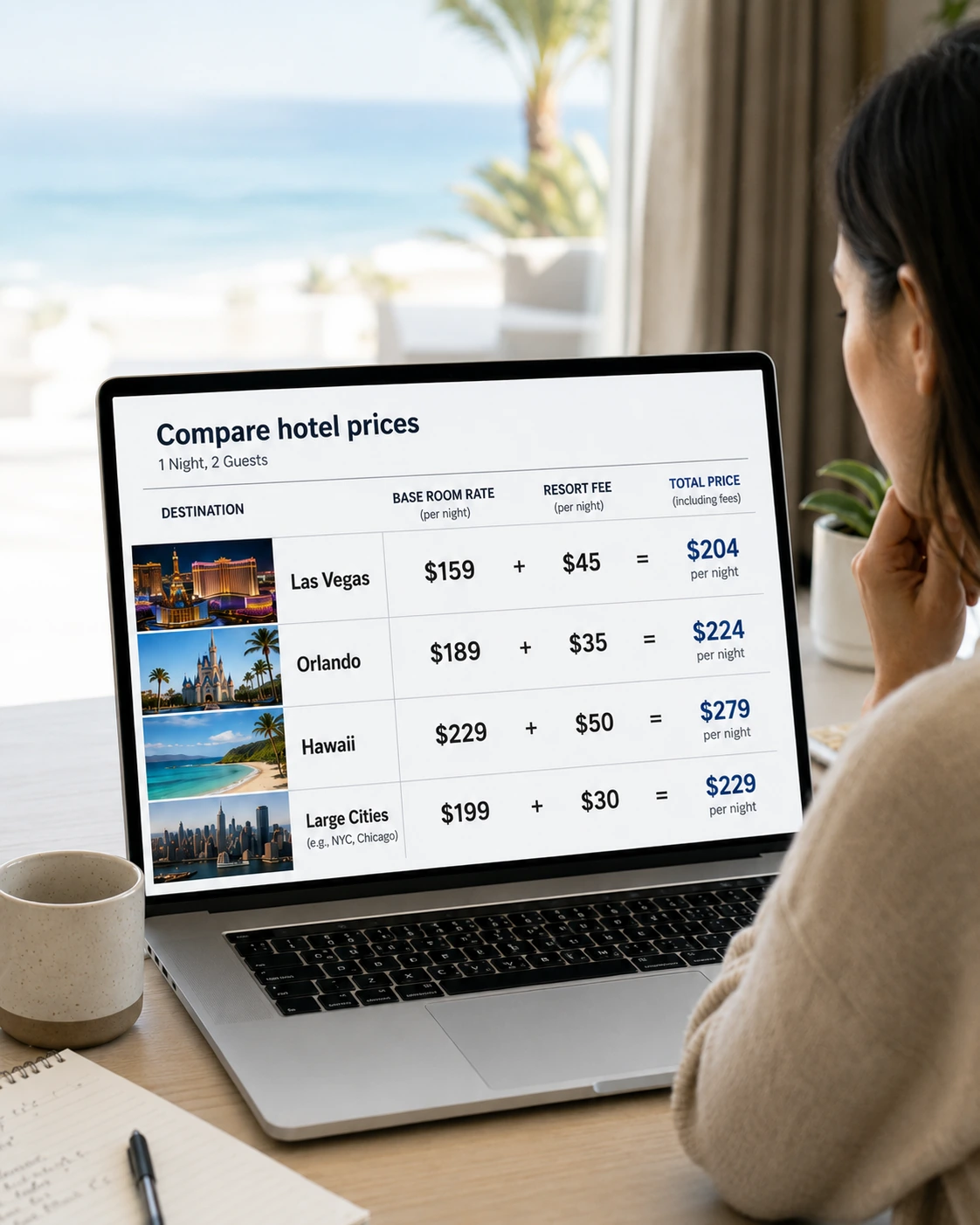
Resort fees are not evenly used across every hotel market. They are most common in destinations where travelers compare many hotels side by side and where properties want the room rate to look more competitive at first glance.
Las Vegas is one of the most aggressive resort-fee markets. A room can look affordable in search results, then become much more expensive once the nightly fee is added.
Orlando hotels, especially around theme-park areas, often use resort or amenity fees to keep the displayed rate attractive while collecting more of the real cost later in the booking path.
Hawaii properties often frame the fee around resort-style amenities such as beach gear, cultural activities, fitness access, or bottled water, but the charge may still apply whether you use those benefits or not.
Large cities may use a different label, such as destination fee, amenity fee, facility fee, or urban fee. The name changes, but the pricing structure often works the same way.
The market matters, but the label matters less. Whether it is called a resort fee, destination fee, amenity fee, or facility fee, the key question is whether the charge is mandatory and included in the price you used to compare the stay.
When Resort Fees Catch Travelers Off Guard
Resort fees usually feel most frustrating when they appear outside the price travelers used to make the booking decision.
That can happen even when the fee is technically disclosed somewhere in the booking path.
The problem is visibility.
A traveler may compare hotels by nightly rate, choose the property that looks cheaper, and only later realize that the resort fee changes the actual cost of the stay.
Price Check
When a resort fee can change the value of the booking
- The fee is charged per night, not per stay.
- The fee is excluded from the rate shown in search results.
- The hotel collects the fee at check-in or checkout.
- The fee applies even if you do not use the amenities.
- A short stay makes the fee a larger share of the total cost.
- A third-party site shows the fee less clearly than the hotel does.
- A non-refundable rate makes it harder to change hotels later.
- The same hotel has another booking path where the fee is included or waived.
A resort fee does not have to be hidden to create a problem. It only has to be separated from the price you used to compare hotels.
Resort fees usually feel most frustrating when they appear outside the price travelers used to make the booking decision.
That can happen even when the fee is technically disclosed somewhere in the booking path.
The problem is visibility.
A traveler may compare hotels by nightly rate, choose the property that looks cheaper, and only later realize that the resort fee changes the actual cost of the stay.
What To Do Before You Book a Hotel With a Resort Fee
The best way to handle resort fees is before you book, not after you arrive.
Once the fee is attached to the reservation, the front desk may not be able to remove it unless your booking already qualifies for a waiver, package inclusion, loyalty benefit, or negotiated rate.
Before choosing the hotel, compare the real nightly cost.
That means looking at the room rate, resort fee, taxes, pay-at-property charges, and any booking terms that affect whether the stay is refundable or changeable.
That same total-cost approach matters when choosing between different types of stays. If you’re deciding between a traditional hotel and an all-inclusive resort, compare the overall value of an all-inclusive vs. regular hotel based on what you’ll actually use and spend during the trip.
Before You Book
Compare the full stay cost, not just the nightly rate.
Before booking a hotel with a resort fee, confirm whether the fee is mandatory, how much it adds per night, and whether another booking path includes, waives, or offsets the charge.
- Check whether the resort fee is charged per night or per stay.
- Look for “due at property,” “collected at hotel,” or “property fees.”
- Add the resort fee to the nightly rate before comparing hotels.
- Check whether taxes apply to the resort fee too.
- Compare direct booking, third-party booking, package, and loyalty options.
- Confirm whether elite status, award stays, or negotiated rates waive the fee.
- Save screenshots of the fee disclosure and booking total.
- Check the cancellation rules before choosing a lower-looking rate.
The goal is not always to find a hotel with no resort fee. It is to know the real cost before the fee changes the value of the booking.
For larger groups, required hotel charges can become even more important when several rooms are needed. Our Orlando Villa vs Hotel Rooms comparison shows how room count, stay length, parking, property fees, and one villa price can change the lodging math.

If the fee is clearly disclosed and included in your comparison, it may simply be part of the hotel’s total price.
The bigger problem is when the resort fee changes the deal after you have already chosen the property based on a lower-looking rate.
Can You Avoid Hotel Resort Fees?
Sometimes — but usually not by arguing at the front desk after you arrive.
Hotel resort fees are easiest to avoid when the waiver, exemption, or inclusion is built into the booking before the stay begins.
That may happen through a few specific paths:
Some hotel loyalty programs waive resort fees on certain award stays booked with points. Some programs or properties may waive or reduce fees for guests with qualifying elite status. Certain corporate rates, group rates, wholesale rates, promotional packages, or direct booking offers may also include or offset the fee.
But the details vary by hotel brand, property, booking channel, and rate type.
The important detail is this:
The resort fee usually has to be handled before the reservation is finalized.
If the booking confirmation shows the resort fee as required, and your rate does not include a waiver, exemption, or package inclusion, the hotel may treat the fee as part of the stay cost.
Check the Fine Print
Not sure if a hotel fee is worth questioning?
Use the Travel Fine Print Risk Checker to review whether your issue is the nightly rate, resort fee, destination fee, pay-at-property charge, booking channel, refund rule, or another hotel pricing detail that could affect your stay.
Travel Fine Print Takeaway
A resort fee is usually part of the hotel’s real price, not an optional amenity charge. Before booking, compare the full stay cost — room rate, resort fee, taxes, and pay-at-property charges — instead of relying on the nightly rate alone.
❓Frequently Asked Questions
These questions cover the resort fee issues travelers usually need to understand before booking, checking in, or comparing hotel prices.
Do you have to pay hotel resort fees?
Usually, yes. If the resort fee is mandatory and attached to the booking, the hotel will normally charge it whether or not you use the amenities.
The main exceptions are when the fee is waived, included, offset, or excluded through the booking terms, loyalty status, award stay, group rate, corporate rate, or another confirmed booking path.
Can you refuse to pay a resort fee at check-in?
In most cases, refusing the fee at check-in does not work because the charge is already tied to the reservation or property policy.
If the fee was not disclosed, appears different from the booking terms, or does not match your confirmation, you may have a reason to question it. But if it was mandatory and disclosed before booking, the front desk may have little discretion to remove it.
Why do hotels charge resort fees?
Hotels use resort fees to separate part of the stay cost from the advertised room rate. This can make the nightly rate look more competitive when travelers compare hotels in search results, map listings, or booking platforms.
The fee may be described as covering amenities, but it often functions as part of the hotel’s pricing structure rather than a charge based on individual usage.
Are resort fees optional if I do not use the amenities?
Usually not. Resort fees are generally not usage-based. A hotel may charge the fee even if you do not use the pool, gym, Wi-Fi, beach chairs, bottled water, local calls, or other listed benefits.
That is why the fee should be treated as part of the room’s real cost before booking.
How can you avoid hotel resort fees?
Resort fees are easiest to avoid when the waiver, exemption, or inclusion is built into the booking before the stay begins.
Some hotel loyalty programs may waive resort fees on certain award stays booked with points. Some properties may also waive or reduce fees for qualifying elite status, corporate rates, group rates, promotional packages, or booking channels where the fee is included in the total.
Are hotel resort fees illegal now?
Not necessarily. Resort fees are not automatically illegal just because a hotel charges them. The bigger issue is disclosure: whether the mandatory fee is shown clearly before booking and included in the price information travelers use to compare hotels.
Rules around fee disclosure can change, and some booking platforms are moving toward showing mandatory fees more clearly upfront. Travelers should still check the booking total, property fees, due-at-hotel charges, and confirmation details before assuming a resort fee will not apply.
Are destination fees the same as resort fees?
They can work in a similar way. Some city hotels use labels such as destination fee, amenity fee, facility fee, urban fee, or experience fee instead of resort fee.
The name matters less than whether the charge is mandatory, how much it adds to the stay, and whether it was included in the price you used to compare hotels.
Is a hotel property fee the same as a resort fee?
A hotel property fee can work like a resort fee if it is a mandatory charge added to the room rate. Some hotels use labels such as property fee, destination fee, amenity fee, facility fee, urban fee, or experience fee instead of resort fee.
The name matters less than whether the charge is required, how much it adds per night, and whether it was included in the price you used to compare hotels.
Bottom Line
Hotel resort fees are not usually optional add-ons.
They are often mandatory charges attached to the room, rate, or property policy.
That means you may have to pay the fee even if you do not use the amenities it supposedly covers.
The real issue is not just whether the hotel charges a resort fee. It is whether the fee was included in the price you used to compare the stay.
A low nightly rate can look like a better deal until the resort fee, taxes, and pay-at-property charges are added. That is why the safest way to compare hotels is to use the full stay cost, not the base room rate.
Before booking, check whether the fee is mandatory, whether it applies per night, whether taxes are added, and whether any loyalty, package, group, corporate, or promotional rate includes or waives it.
The hotel with the lowest nightly rate is not always the hotel with the lowest real price.
Related Guides
If you are comparing hotel prices or trying to understand why the final cost is higher than the nightly rate, these related guides may help:
Hotel Fees and Added Charges
- Do You Have to Pay Hotel Destination Fees?
Use this if the charge is called a destination fee instead of a resort fee. - Hidden Travel Fees Explained
A broader guide to the extra charges that can change the real cost of a trip. - Why the Price You See at Checkout Isn’t the Price You Pay
Helpful if the issue is the difference between the displayed price, checkout total, and final amount charged.
Hotel Payment Timing and Property Charges
- Pay Now vs Pay at Hotel: What Travelers Should Know Before Booking
Useful if the resort fee, taxes, or property charges are collected later instead of included in the prepaid amount. - Hotel Incidental Holds Explained
Helpful if the issue is a temporary hold, deposit, or authorization that appears at check-in.
Hotel Deposits and After-Stay Charges
- Do You Get Hotel Deposits Back? What Travelers Should Know Before Booking
Helpful if the concern is a hotel deposit, incidental hold, or refundable pre-arrival charge. - Can Hotels Charge You After Checkout?
Use this if a fee, adjustment, or hotel charge appears after the stay ends.